

On 29 May 2026, FID Media will host a workshop for the research community in Leipzig. Participation is open to all interested researchers and, like all FID Media services, is free of charge. Registrieren Sie sich jetzt unter diesem Link! Register now via the registration link. Registration closes on 29 May at 10:00 a.m. Please note, however, that for catering purposes only registrations received by 18 May can be taken into account.
Title: From Digital Corpora to Research Data in Communication and Media Studies: Responsibilities, Methods, and Infrastructures
Date and venue: 29 May 2026, 10:00 a.m.–4:00 p.m., Lecture Hall, Bibliotheca Albertina (Beethovenstraße 6, 04107 Leipzig)
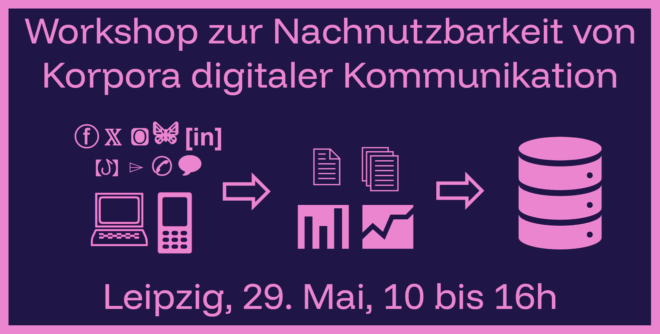
The workshop is guided by the central question: What remains of digital communication corpora once a research project has ended, and how can their reuse for scholarly purposes be improved?
Description: Digital communication environments, ranging from social media platforms and messaging services to digital and digitised newspaper archives, generate a wealth of potential research data for communication and media studies. Many research projects use these resources to create extensive digital corpora. Once projects have ended, however, these corpora often remain difficult to discover and only partially reusable, owing to copyright and data protection requirements as well as the complex technical conditions necessary for their reproducibility. The workshop takes these challenges as its starting point and explores how digital communication corpora can be collected, documented, and made available for scholarly reuse. It will address both methodological and epistemological questions relating to the datafication of communication. Particular attention will be paid to the conditions under which digital corpora—despite often being impossible to archive in their entirety—can generate greater analytical value for communication and media studies through standardised documentation and improved interconnection. The workshop will also examine the role that research infrastructures may play in supporting these processes in the future.
Program:
Registration and welcome coffee (9:00–10:00)
Welcome and opening remarks (10:00–10:15)
Panel 1 (10:15-12:15): From Digital Communication to Research Corpora
Key questions: How are traces of digital communication and digitised journalistic content transformed into research data – how do methodological, epistemological and practical decisions shape this process, and what potential does it hold for new perspectives?
Chair: Patricia Blume
Presenters:
| Katharina Kinder-Kurlanda (D!ART Universität Klagenfurt; CAIS): | Big Social Media Data als epistemologische Herausforderung für die Sozialwissenschaft |
| Erik Koenen (ZeMKI Bremen): | Epistemische Fragen der Digitalität und Digitalisierung |
| Vanessa Angenendt (Universität Duisburg-Essen): | Datenspenden und Misogynie in Chat-Kommunikation |
Lunch buffet in the foyer (11:45-12:45)
Panel 2 (12:45 – 14:15): From the Corpus Silo to a Reusable Research Data Landscape
Key questions: Why do digital corpora disappear after project completion, and how can a corpus that is not fully shareable still be discoverable, citable and usable for synergies?
Chair: Lydia Riedl
Presenters:
| Vincent Fröhlich (Universität Erlangen-Nürnberg): | Von volatilen Plattformdaten zu nachhaltigen Forschungsressourcen: Infrastrukturelle Bedarfe der Social-Media-Forschung im Bereich Demokratie- und Rechtsextremismusforschung |
| Birte Kuhle (CAIS): | Praktische Herausforderungen im Umgang mit Social-Media-Daten im Forschungszyklus |
| Philipp Knöpfle (IfKW der LMU München): | Was bleibt? Replizierbarkeit und Reproduzierbarkeit computationaler Kommunikationsforschung und die Rolle offener Daten |
Coffee break (14:15-14:30)
Panel 3 (14:30 – 16:00): Analysing Interconnected Communication Corpora – New Potential for Insights and Pitfalls for Communication and Media Studies
Key questions: What conditions must data meet for analyses using methods of Computational Communication Science (CCS) to be valid in the first place? What new analytical and epistemic potentials emerge when digital communication corpora become discoverable, well-documented and interoperable?
Chair: Kai Matuszkiewicz
Presenters:
| Marko Bachl (FU Berlin; Weizenbaum Institut): | Bias und epistemische Konsequenzen von Computational Communication Science | ||
| Jakob Jünger (IfK der Universität Münster): | Normdaten und Knowledge Graphs als Grundlage für Sekundäranalysen in den Sozialwissenschaften
| Felix Victor Münch (GESIS, HBI): |
Transkription, Translation, Transformation: Chancen der plattform-, medien- und sprachübergreifenden Verknüpfung von Kommunikationsdaten durch Large Language Models |
|
Final discussion (16:00-16:15)